Therukoothu
Therukoothu is the traditional art form of
folk theater of Tamilnadu and it has a long history. This dynamic art
form combines spoken word, song and dance. It is a rich and vibrant art,
popular among the rural population. Its themes are drawn from Indian
mythologies and epics, particularly from the Mahabharatha and nowadays
from the Ramayana.
Therukoothu is not merely a form of theater. It is bound with people's
emotions, values, attitudes to life which are reflected in the many
rituals that accompany this art. The rituals around Koothu relate the
community to the art in such a way that Koothu becomes an expression of a
reality as felt and experienced by a people.
Koothu is performed at Shakthi (mother Goddess) temples, generally
between March and July every year. The performance begins late in the
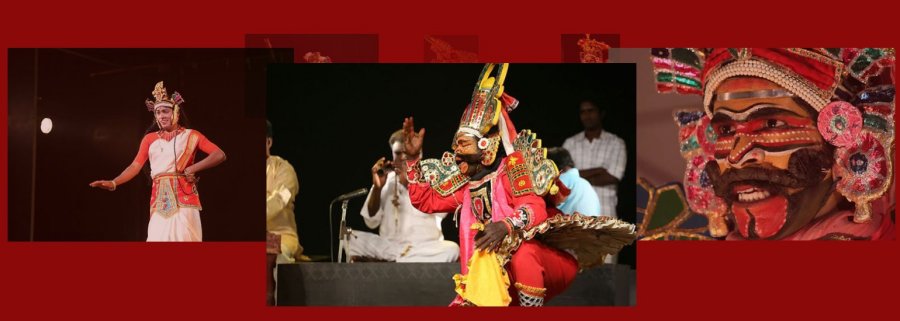
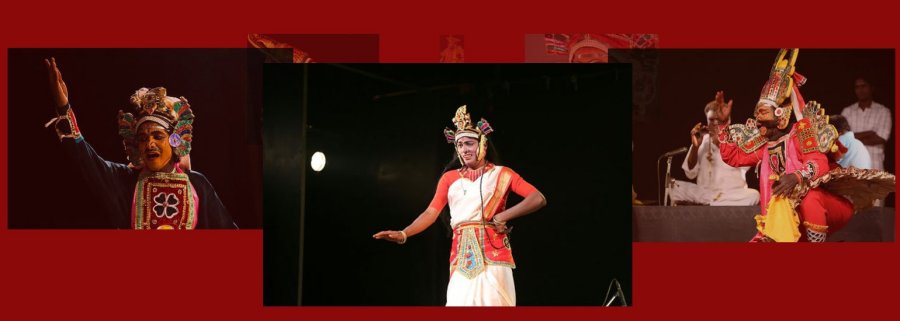
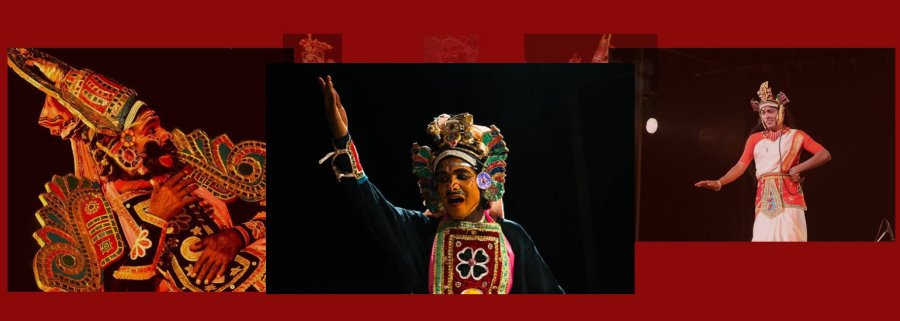
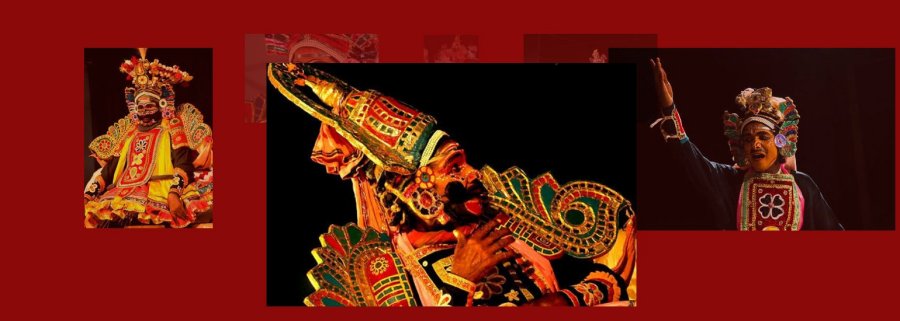
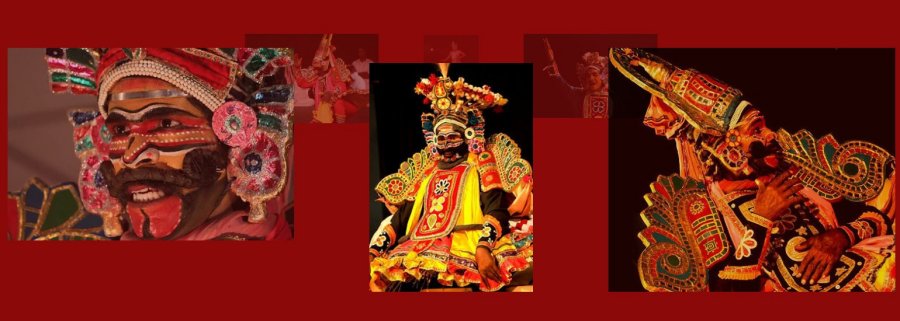
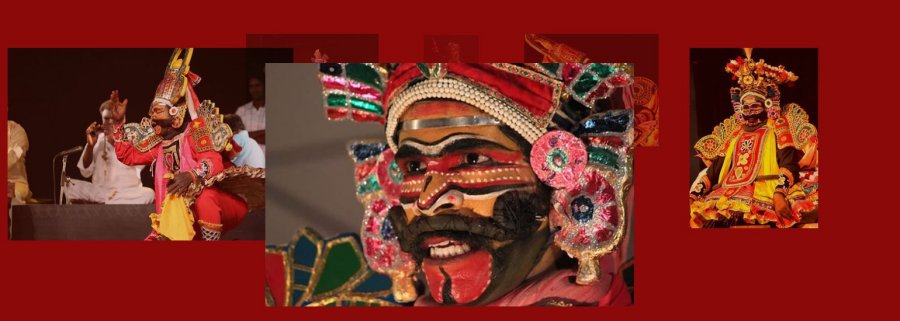
evening and lasts throughout the night. The costumes prescribed by
tradition are tall head gears, arm and shoulder gears, breast shields
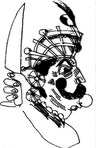
and painted face masks, highly exaggerated and rich in colour. It
employs simple musical instruments like Harmonium, Mridangam,
Mukhaveenai and Cymbals as accompaniments.
|
Our Manram
Purisai a village about 120 kilometers from
Chennai has been a traditional center of Therukoothu. This folk form has
been nurtured for nearly six generations by a family of Theru-k-koothu
artistes, presently represented by Purisai Duraisami Kannappa Thambiran
Parambarai Therukoothu Manram.
Purisai, well known for this art form, is a village in Thiruvannamalai
District, Tamilnadu. Most of the artistes for whom Koothu is a
hereditary art, belong to this village. Purisai Kannappa Thambiran's
troupe which now gives the performance is the most renowned among the
Koothu troupe of south India.
Purisai Duraisami Kannappa Thambiran Parambarai Therukoothu Manram has
been keeping alive a distinct style of Theru-k-koothu associated with
Purisai village in the Thiruvannamalai district of Tamilnadu, about 125
kilometer from Chennai. Theru-k-koothu is a multi-dimensional folk
theatre, which is at once an entertainment a ritual, a medium of social
instruction, preserver of epical myths and has a history of nearly two
to three centuries.
Koothu has been in the recent years receiving attention and
encouragement both from people and Central and State Governments, thanks
to the initiatives taken by a group of writers and theater enthusiasts.
The union Education Ministry has enabled the group with periodic grants
to produce many new plays. As a result, the Purisai troupe led by its
leader Kalaimamani Kannappa Sambandan, with encouragement from
N.Muthuswamy, an eminent contemporary playwright and director, is
widening its repertoire. It has started producing plays from Ramayana,
another major Indian epic. These productions have improved the
capabilities of the troupe, have widened the scope of the art and
enhanced its appeal.
Purisai Koothu has been practiced for nearly five generations now. This
Koothu form has been sustained by Kalaimamani Purisai Duraisami Kannappa
Thambiran after the death his father Duraisami Thambiran. This Koothu
group was registered as an association in 1980 under the name Purisai
Duraisami Kannappa Thambiran Parambarai Therukoothu Manram. In 1982
Sangeet Natak Akademi provided financial grant for five years to this
organization for training young artists in the art of Koothu. From that
time onwards many young people came forward to perform Koothu. Some of
those who got trained under the scheme secured the young talented
Artists fellowship from the Govt.of India, Ministry of HRD.
It has had exponents of the art like Raghava Thambiran, Natesa Thambiran
and Kannappa Thambiran. This troupe has withstood the test of time and
the upsurge of other popular media and has sustained the authenticity of
tradition.
This group has to its credit different Koothu productions such as Vali
Vatham, Indrajit, Hanuman Doothu, Ravana Vatham, Thenaliraman,
Surpanagai Sabatham, Seetha kalyanam and Padukalam. Another
distinguished feature of this group has been the innovative production,
the stories for which have been culled from world famous writers. For
example the play titled 'An old man with huge wings' based on the story
by Gabriel Gracia Marquez, the Colombia Nobel prize laureate was made
into a Koothu in collaboration with the Mapa theatre of Colombia. This
Koothu was staged at Bogota, Colombia in 1996 during the 5th
International Theatre Festival, which received all round appreciation.
This was a path breaking effort on the part of a Koothu group from a
remote village in India making its presence felt in a distant continent.
Similarly, the German story "Caucasian chalk circle" by German writer
Bertolt Brecht's was also staged as Koothu.
Thus Purisai Duraisami Kannappa Thambiran Parambarai Therukoothu Manram
was the first to step out of the traditional themes and try foreign
themes. By this bold step Koothu received an international recognition
and exposed the culture of India to other countries and languages.
The Purisai troupe was invited to perform at the inaugural function of
Festival of India in France (1985) and Sweden (1987). The troupe was
invited to Singapore by Government of Singapore to perform at a theater
festival (1990). The troupe also took part in the 5th International
theater festival at Bogotá, Colombia (1996) and the festival of
Imaginary, Paris (1997), 65th birth Anniversary Festival of Neelan
Tiruchelvam in Srilanka (2009) and performance at 25th Republic Day
Parade at New Delhi (2009).
|
|
|